Armatures for scale figure sculpting

I just started to redo the figures that go with the Panzer I and the PaK 37. Here, I would like to show how I build up my figures.

I start with building an armature from wire. I take two pieces of wire (e. g. brass, 0.6mm), and twist them together to form the “spine” (pictures 1 and 2). I then bend the arms and legs (picture 3), and add a “neck” made from a short piece of wire to the spine (picture 4). Finally, I partially fix the armature by adding a “pelvis” and a “chest” from Magicsculp (picture 5):

To get the size of the armature right, I searched on Google for a skeleton picture used by artists to help in painting humans. This was then scaled to 1/35 scale and printed. So I can check the appropriate size of my armature by simply placing it on the printout.
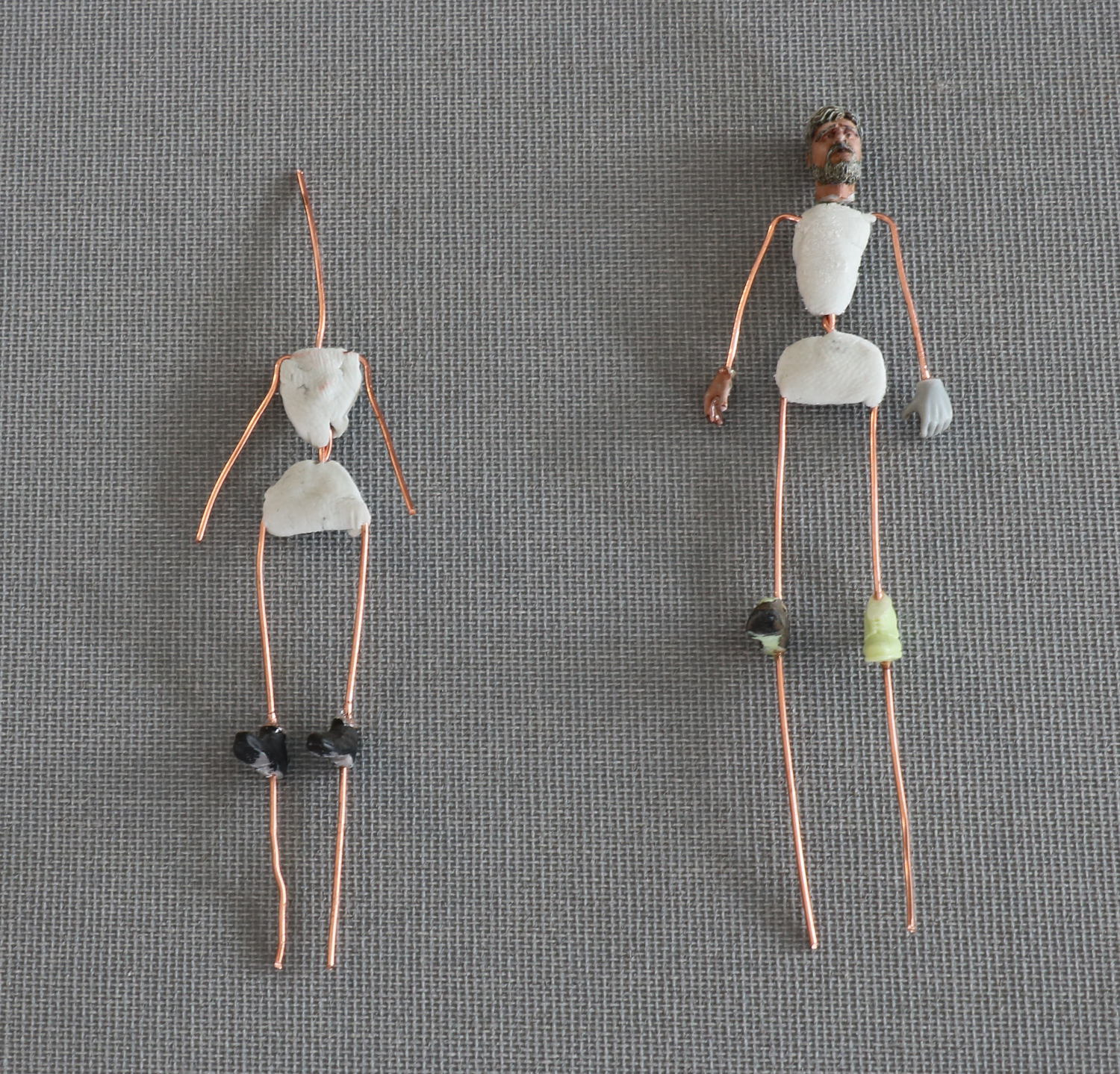
Russian peasants

Looking back at my sculpted figures, I realized that I have to practice and to refine my skills there much more. I browsed through some war gamer sculpting web sites, looking at the different techniques used.

Then I decided to redo the Russian peasant couple from the Panzerbefehlswagen I scene. I started creating armatures using two pieces of intertwined copper wire, that was then strenghtened using putty  at the chest and the pelvis region. Then I added shoes and also a head (only temporary):

sculpting-armatures

I then bent the armatures to their respective poses, and fixed these by adding putty to the wires. It looks quite ugly, but it does the trick.

Then I added again some putty to build up the body proportions, and started with the clothing. The peasant has his trousers added, and to the female figure I added the upper part of  her dress, as well as some stockings (as far as the will be visible below the dress:

Now I have finished the two figures, but unfortunately I did not take any pictures while I was sculpting. So these are the finished figures:

Both were sculpted based on historical pictures, like the original figures I made. The guy got a cap, as I did not really like his original hair style. I also changed the legs of the peasant figure, as I had two nice legs available from another conversion project.

Now the figures are painted:

Continued to work on the pak crew

In the meantime, I made further progress with the crew for the anti tank gun. The first figure is finished, and already fixed to the base:

Sculpting on the second figure is also finished, and painting is on its way:

The face only received a first layer of color, with the eyes added. The insignia on the helmet are Archer transfers, which are perfectly applicable using their wet transfer paper.

The last figure is still in the sculpting stage:

Now I also finished the second figure:

And another figure…

As I enjoyed sculpting the other guys so much, I could not resist to add another figure that will be pushing on the Opel Blitz truck:

On the bread bag the canteen and the water bottle will be placed, as well as a Kar98 rifle over the shoulder.

Update: Now the figure is painted and fixed to the base:

Sculpting the third soldier

After finishing the frame body of the third figure, I added the boots, building them up from the soles on with a lot of sanding in between. Then I added the trousers legs (as far as they will be visible), and started working on the coat:

Building the soles from putty is not that satisfying, so I will try using sheet styrene instead. The last picture shows one part of my work – in – progress sole stack.

I made quite some progress:

And I am not so sure about the soles. Perhaps it is better to use putty, but to start with the heels…

Working with epoxy putty

For all changes to my figures I made until now I used the standard Milliput putty. I also have some Magic Sculpt on the shelf, that I will try later.

It is very important to work with very thinly rolled sheets of putty. To roll out putty, I use baby powder. Pour some powder on a smooth even surface, and you can start, using some round piece of metal.

To apply and smooth the parts made from putty I use rubbing alcohol. If you want to touch up some areas on already painted figures, you can also use tap water thus avoiding to remove the paint again by accident. If some putty is left, you can keep it in the freezer, where it should stay workable for at least 24 hours.

I have just started to use putty for remodelling figures, but I think the key is to work in single layers, and to always wait for the putty to cure in between. So you have a lot of control over the process and are safe from accidentaly damaging already sculpted areas again.