Milliput tarp for the cargo bay

I added a tarp made from Milliput to the cargo bay. It could show more wrinkles, but apart from that I am happy with the result. To get such a large flat sheet of Milliput, I used two sheets of baking paper, a lot of baby powder and a rolling pin, which worked great.

The pictures below show the tarp almost finished, the straps of the side covers, the attachment to the holding loops and some seams are still missing.

I also mounted the cargo bay to the frame without any problem, and added some splashes from thinned oil paint.

The cargo tray is finished

After a well deserved holiday break, I finished the cargo tray of the Opel Blitz. It was painted, chipped using a sponge, and then dusted using pigments with white spirit. This worked quite well, but the resulting dust layer is quite intense. But this should not be a problem, as it will be followed by a dark pin wash. And that is how the cargo tray looks like:

The wooden rod you can see on the pictures is fixed with a screw to a piece of sprue glued into the cargo tray to ease handling. As I intend to also add a tarp from putty, I do not care about the interior of the cargo tray…

I also finished painting the drivers cab, chipped it and dusted it:

So from now on I can really enjoy weathering, weathering and even more weathering… 🙂

Continued my work on the base

In the meantime I fixed the frame of the truck to the base, and added some touch ups with Celluclay. Then I added a pigment layer and a first oil wash (dark mud):

Besides the truck, I added two shovels. The smaller one is from the Opel, the other one from a resin tool kit.

I also started to construct the cargo area. Using the PE set, it is built from a frame made from brass, and some styrene plates (included in the PE set), that have to be crafted to look like the original wooden parts. I decided to use the kit parts instead, as they have a very nice wood structure. I carefully removed all the molded parts like hinges, fixations etc. with a chisel. As the PE parts will be located at exactly the same places as the molded parts, this should turn out fine in the end.

The brass underconstruction is already soldered together, has a nice fit and is quite stable. Actually I am quite happy that I soldered all the parts together, as I have no idea how this should go together using only superglue.

This is real fun, but still enough work to do…


More progess

Meanwhile I did quite some work on this project. The frame has been painted and weathered:

The exhaust has been painted with the Lifecolor rust set, dust and dirt is applied using oils and enamels. I prefer enamels for dust, as they dry much faster and to a totally matte finish when thinned with white spirit. The subtle chipping was done using the good old sponge technique. The dust on the spare wheel is still a bit too bright, and the mud is completely missing.

The wheels were also painted and received a first dust layer:

The driver’s cab is now completely built and painted. Unfortunately I forgot to take a picture from the finished driver figure:

I have seen a cover on the searchlight on some historical pictures, so I decided to also cover the searchlight of the truck. I think it will look much better than the plastic lense from the kit. Please also note the cable running down from the searchlight. The decals are from the Tamiya kit. The trailer indicator (the yellow triangle on the roof) is folded down, as now trailer will be towed…

The complete weathering is of course still missing, as well as some touch ups.

Finally, a view on the base:
 

Sockel 01

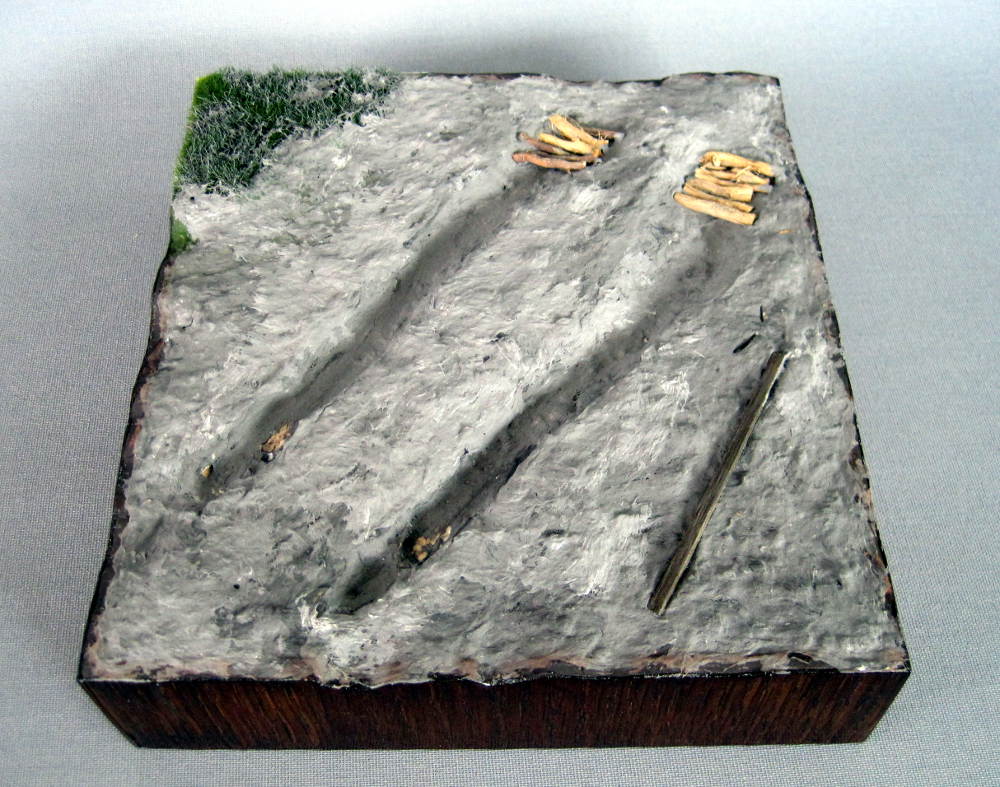
It is built the usual way from plywood and veneer, and then covered with Celluclay. The wooden beams (made from roots) will be located below / behind the rear wheels. I will continue with adding a pigment layer, much more painting and adding some more details (above the wood plank to the right you can see two holes, where two shovels will be attached).

Still some way to go…
Further progress

I added dirt to the driver figure and the driver’s cabin:

The dirt is made from pigments, oils and enamels. I also like the look of the seat bench, the dust in the seams is made from enamels, and the patina from oils. The base color is acrylics.

Then I fixed the driver to the bench:

I also continued to paint the head:

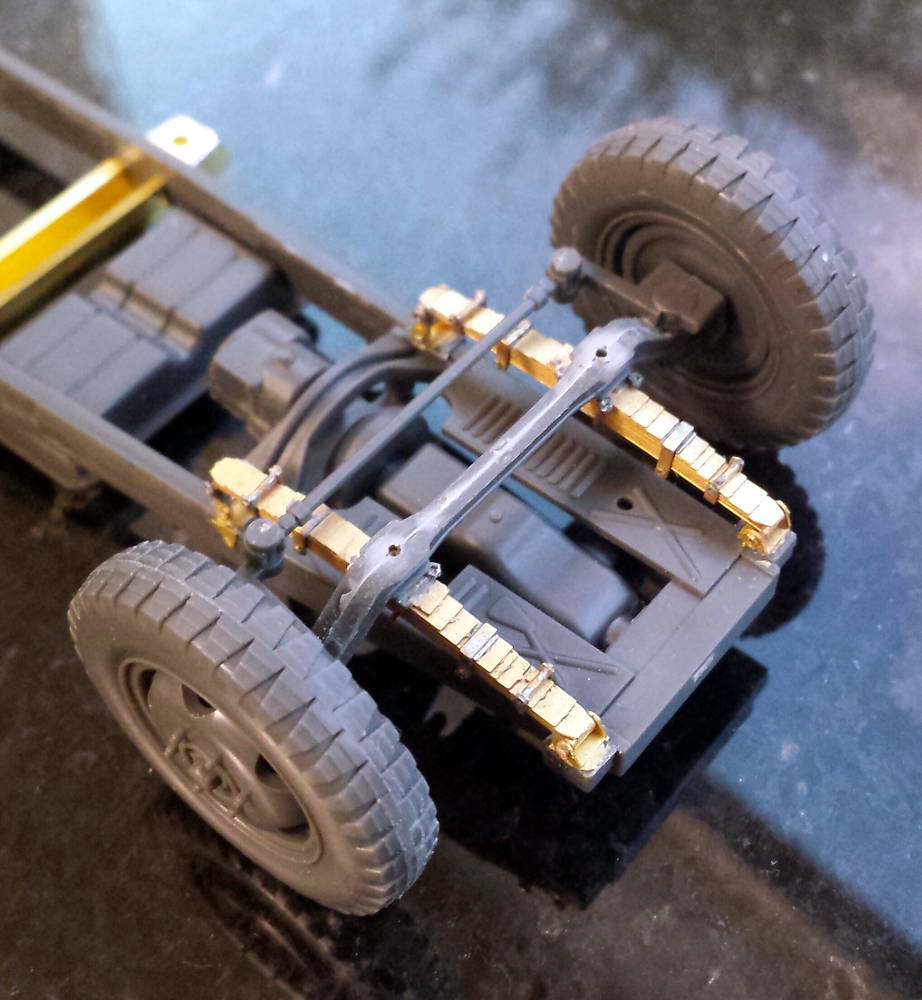
The frame of the Opel is also finished. I added the rear leaf springs, and also snow chains on the rear wheels (this can often be seen on historical pictures of vehicles driving through mud):


Some progress

In the meantime I finished the driver’s figure:

The boots and the trousers will be weathered with some mud, and the head (as well as the hands) only received the first layer of skin color. The head is from Hornet, and really very finely detailed.

The already built part of the Opel’s driver cab has been painted and the first weathering steps are also visible: some fading with oils, sponge chipping and added dirt on the floor. The dashboard is almost finished, the only things missing are the glass covers of the different displays and perhaps a piece of cloth in the tray.

The color is Tamiya German grey, on top of it I sprayed some acrylic varnish. The varnish is supposed to be matte, but to me it adds a very nice satin finish.

The leaf springs are also almost finished. They are quite good to build, and soldering most of the parts really helps. I already mounted the front axle to the frame:

Federn 01


The driver’s cab

I continued to rework the driver figure. Now I also used Magic Sculpt. This putty is much softer than Milliput, and is therefore much easier to feather into existing details. For details that are better made from some harder material, it is advisable to let it cure for a while or to switch to Milliput instead.


And that is how the figure looks like now:

The right arm and the touch ups on the collar are made from Magic Sculpt.

I also continued building the driver’s cab:

The dashboard is now finished. Building the hood from the PE parts in the set is a delicate task, but the louvers on both sides are nicely detailed and definitely worth the effort. Now some parts are still to be added, and then this group will be painted (without roof, doors and back wall for the time being). Until then the driver figure will also be finished.

New project – Opel Blitz 3t cargo truck stuck in Russian mud

After finishing the BMW R75, I started a new project: One of the famous Opel Blitz 3 ton cargo trucks stuck in mud and being pulled out. For some inspiration, have a look at https://en.wikipedia.org/wiki/Rasputitsa

I use the kit from Tamiya, together with a PE upgrade set from Voyager. I also found some real leaf springs on the web from Minor.

I will add some figures as well, but I will now start with building the Opel. The first part will be the drivers cab, followed by the frame and the cargo bay. It looks like it is possible to build everything separately and join the three construction groups at the very end of the construction. The PE set comprises some additions to the cab and a complete rebuild of the cargo bay. Looks challenging…

Some first pics of the cab:

The clutch is pressed, the other parts are all from the PE set. The dashboard lacks some switches and buttons to be scratchbuilt.

I want to use one of the two figures included in the Tamiya kit as driver. They are very poorly moulded, so I started to rework one figure. I changed the boots to fit them to the clutch pedal and the throttle, and added a Hornet head. I just started to sculpt the uniform jacket again: